Publications and talks

What we present to Swiss organisations: our conference talks, articles and case studies, newest first. A summary for each publication, the details, and the full document (in French) one click away.

Study · French-speaking Switzerland municipal barometer, September 2026

What 1,291 residents of French-speaking Switzerland say about their municipality

· Qualinsight survey, July 2026 · 4-page summary · French · PDF

A representative survey of French-speaking Switzerland (1,291 respondents, all cantons, ±2.7% margin of error), self-funded and made available to municipalities as they decide their 2027 budgets. Quality of life, priorities, heat, safety, isolation, participation, information and digital services: the figures, the urban-rural gaps, and nine questions about your municipality.

Read more

Key points

  • Quality-of-life score of 8.1 out of 10 and 82% satisfied, but only 43.7% trust municipal authorities: a third take no position either way.
  • Four priorities within less than four points (safety, green spaces and heat, mobility, affordable housing), and a ranking that reverses between town and countryside.
  • Three blind spots that never reach the front desk: 66% struggle during heatwaves (78% of tenants), 34% of women do not always feel safe in the evening, 30% isolation, including 34.5% of 17-24 year olds.
  • 65% want to give their opinion more often, 6% do. The online survey is the leading participation channel at all ages; the public assembly mobilises 5% of 17-24 year olds.
  • 28.1% do not feel well informed: a full quality-of-life point separates the well-informed from the rest, for the lever with the lowest unit cost.
  • Digital: 29% could not find the information, 13% hit a technical problem. Post and the municipal newsletter remain the leading channel, including among 17-24 year olds.
Download the summary (PDF, French) Full presentation (34 slides) and per-canton detail on request. See the municipal offer →

Article · Bulletin des communes romandes, September 2026

What if your minutes wrote themselves during the meeting?

· Special feature “Minutes and sovereign AI” · Esther Sève · French · PDF

Monday, 10.30 pm: the executive meeting ends, and the minutes are still waiting the following Wednesday. The article starts from this reality, describes how everyone improvises their own method (notes on the fly, dictaphone, replaying in thirty-second chunks) and shows what AI-assisted transcription changes when data stays in Switzerland and people keep the final say.

Read more

Key points

  • A two-hour meeting routinely turns into three to four hours of writing, whether you are a part-time secretary, a clerk's office or a city equipped with meeting tools.
  • A transcription tool is purely internal: no interface with citizens, no cantonal dependence. Each municipality can choose on its own, and the decision remains reversible.
  • Public, tiered pricing: CHF 10 per audio hour individually, CHF 6 in a 10-hour pack, CHF 2.40 on an annual subscription of 50 hours per month. A single credit for the whole municipality.
  • The “municipal minutes” template exists in direct and indirect speech, with agenda integration; committee minutes are coming soon.
  • Hosting and processing at Infomaniak in Geneva, no reliance on OpenAI, Google or Amazon, never any training on your data, DPA on request.
  • 5 free hours for Bulletin readers: write to us mentioning the article.

Demonstration on public documents · August 2026

Your minutes, from sound to document

· Presentation · Esther Sève and Nadia Benkara · French · 24 pages with step-by-step appendices

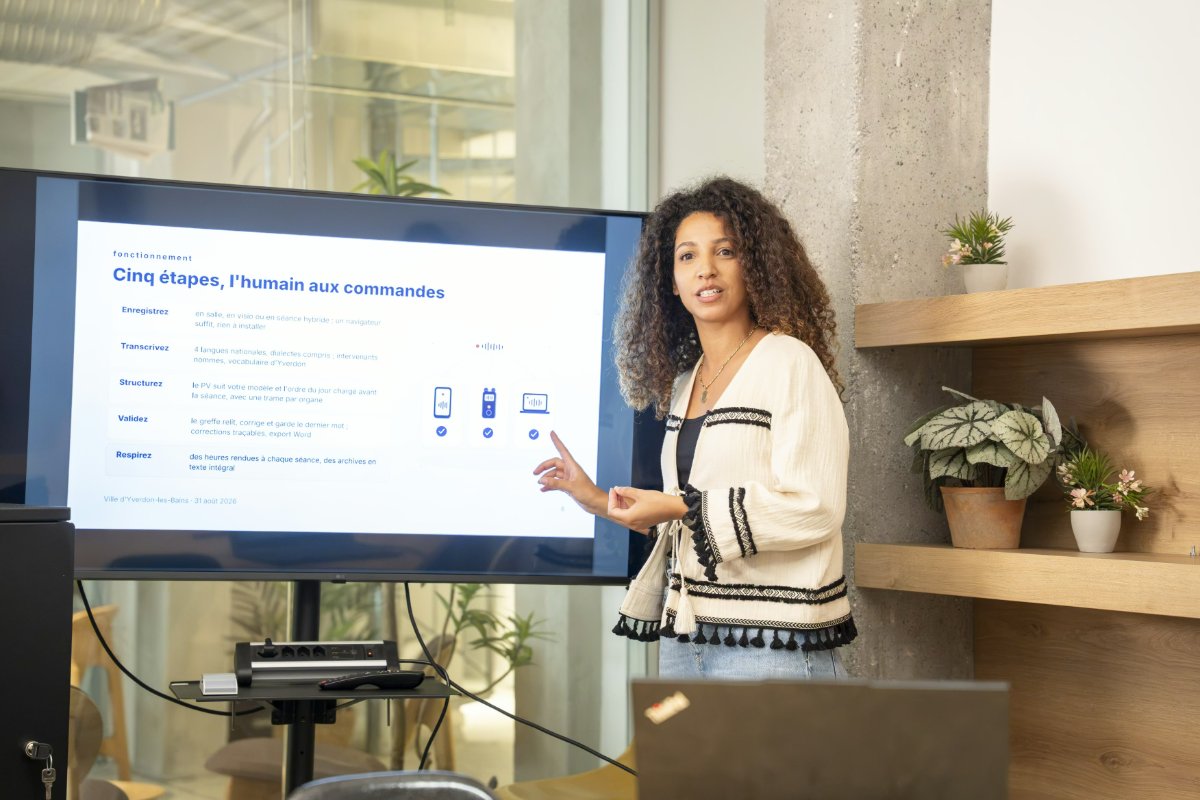
Nadia Benkara presents the five steps of Swiss Transcript, from recording to minutes
Nadia Benkara presents the five steps, from recording to minutes.

Rather than a generic demo, we reconstructed a public meeting of the Yverdon-les-Bains municipal council (30 April 2026) from public documents alone: the agenda and the broadcast recording. As output, the full transcript with named speakers, then minutes generated in direct speech, compared with the published official minutes. Demonstration carried out on our own initiative, without a mandate from the City.

Read more

Key points

  • 1 h 42 of meeting transcribed, 32 speakers identified (including a contribution of a few seconds), 13 agenda items covered with votes and decisions.
  • About 15 minutes to prepare the lists the first time (32 speakers, 28 terms, 31 proper names, 17 acronyms such as AggloY or Travys), reused at every subsequent meeting.
  • “Speaker 1” becomes the councillor's name, “d'hiver dans les bains” becomes Yverdon-les-Bains again: every correction remains visible and verifiable against the original transcript.
  • Five steps, people in control: record, transcribe, structure by agenda, approve, breathe.
  • Three families of solutions on the market (meeting management tools, parliamentary platforms, hybrid models) and Swiss Transcript's place: a standalone building block today, an API at the end of September 2026, connectors in time.
  • Budget: CHF 10 per hour individually, CHF 60 for the 10-hour pack, CHF 120 per month for 50 hours on an annual plan (CHF 2.40 per hour). A single credit shared between secretariats, departments and committees.
Presentation and demo video available on request. Learn more →

Talk · AI Days Fribourg 2026

Sovereign AI, brick by brick

· Esther Sève, co-founder · 17 pages · French · PDF

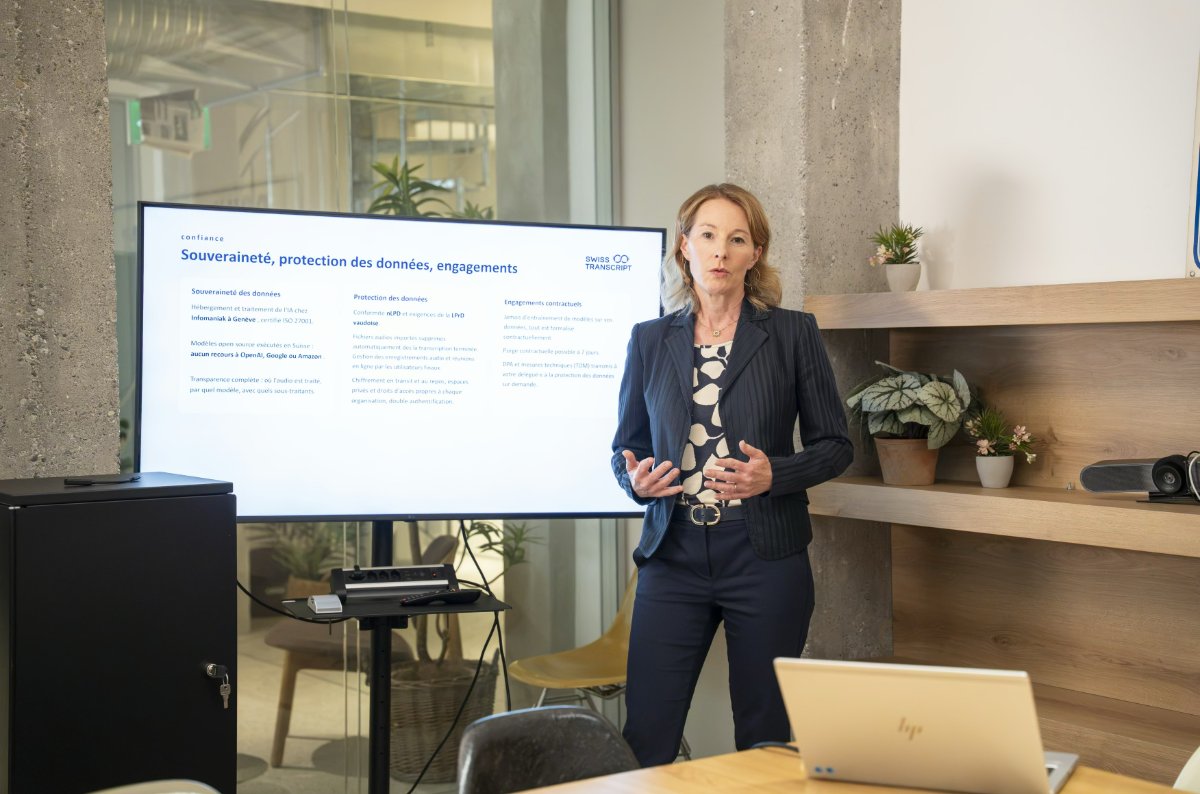
Esther Sève presents data sovereignty and Swiss Transcript's commitments
Esther Sève on data sovereignty, protection and contractual commitments.

A talk on AI adoption at work in French-speaking Switzerland and the risk of “Shadow AI”: consumer tools used without approval, data leaving to train models outside Switzerland, responsibility perceived as organisational. The proposed answer in three words: sovereign solutions, clear policies, awareness. The presentation ends with feedback from the pilot run with a health insurer in a highly sensitive environment.

Read more

Key points

  • 43% of surveyed workers in French-speaking Switzerland use AI regularly; 52% report “much higher” use than one or two years ago.
  • 27% use AI tools without official approval; 26% say no clear rules exist in their organisation. 70% believe the employer is responsible for proper use.
  • Three levels of Shadow AI risk: the employee (unauthorised tools), the organisation (leaks and dependencies), the data (FADP/GDPR compliance, sovereignty).
  • Acceptance of recording is built: prior announcement, explicit consent, purpose limited to the minutes. Strong reluctance when recording is done “on the sly”.
  • Three building blocks for sovereign AI: transcribe (FR, DE, EN, Swiss German, diarisation), summarise (custom templates, glossary), decide (executive summary, traceability).
  • Health insurer pilot: bilingual French and Swiss German, professional prompts, Infomaniak hosting, automatic deletion of sources. Challenges: reluctance to record in emotional contexts, importance of human contact, health data.

Organising a conference or workshop?

We speak on sovereign AI, Swiss German transcription and meeting documentation in municipalities, care networks and insurers. Also follow our publications on LinkedIn.

Contact us